
The latest PMI showed inflation pressures ebbed further last month with both costs of raw material and prices charged rising at a slower pace than March.
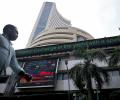
RBI policy, macro data, company earnings to decide market course this week: Experts

Bumper liquidity as a result of global central bank stimulus measures should prevent a sharper downturn.

The pace of activity in China's vast manufacturing sector quickened for the first time in 13 months in November, a survey of private factory managers found, adding to evidence that the economy is reviving after seven quarters of slowing growth.

ICICI Bank was the top laggard in the Sensex pack, sinking over 10 per cent, followed by Bajaj Finance, HDFC, IndusInd Bank, Axis Bank and Maruti. Bharti Airtel and Sun Pharma were the gainers in the BSE index. NSE Nifty suffered a heavy loss of 566.40 points, or 5.74 per cent, to settle at 9,293.50.
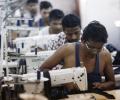
That prompted manufacturers to add jobs for the first time since June.
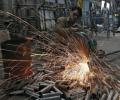
Manufacturing growth in India lost momentum in February.
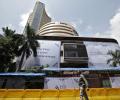
ONGC was the top performer while private banking major ICICI Bank extended gains

The Nikkei India Services Purchasing Managers' Index, which tracks services sector companies on a monthly basis, stood at 52 in September, down from August's 43-month high of 54.7, pointing to a slower and moderate rate of expansion.
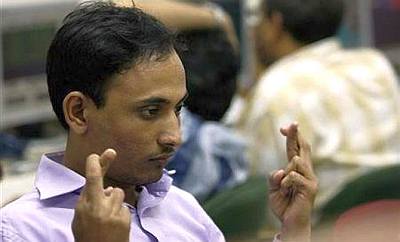
Markets closed the day in green on favourable domestic factors,
A reading above 50 means the sector is expanding, while a reading below 50 means contraction.

'The real lifting of the economy will happen only if this momentum sustains in the coming months.'

Finance Minister Nirmala Sitharaman on Thursday announced a new job creation scheme by giving subsidy to those establishments that make new hires. The subsidy would be to cover for retirement fund contributions by employees as well as employers for two years, she said. Employees contribution (12 per cent of wages) and employer's contribution (12 per cent of wages) totalling 24 per cent of wages would be given to establishments for two years, she said. Under the Aatmanirbhar Bharat Rozgar Yojana, every Employees' Provident Fund Organisation (EPFO)-registered establishment taking new employees would get this subsidy.

The trade impact of the coronavirus epidemic for India is estimated to be about 348 million dollars (approximately Rs 25 billion) and the country figures among the top 15 economies most affected as slowdown of manufacturing in China disrupts world trade, according to a UN report. Estimates published by United Nations Conference on Trade and Development on Wednesday said that the slowdown of manufacturing in China due to the coronavirus (COVID-19) outbreak is disrupting world trade and could result in a 50 billion dollar decrease in exports across global value chains.

Amid decelerating economic growth and falling industrial output, India's services sector has shown signs of promise in May recording the fastest pace of growth in the past three months, says an HSBC survey.

The Chinese economy is not collapsing, it is shifting to different growth drivers which the old metrics used to judge China do not pick up.

Losses largely came from the metal index, followed by power, infrastructure, realty, PSU, oil and gas, capital goods, FMCG, healthcare, auto and banking.

The GST rate for the sector has not yet been finalised by the government.

FY22 will be the year to rebuild with the IMF projecting output growth at 11.5 per cent, economic survey at 11.0 per cent and the RBI's Monetary Policy Committee at 10.5 per cent.

'We expect the Reserve Bank of India to deliver a 25 bps rate cut in April to support growth.'

The finance ministry on Tuesday cited "green shoots" of recovery in agriculture, manufacturing and services sectors, and said the prompt policy measures taken by the government and RBI have helped reinvigorate the economy with minimal damage. Stating that the agricultural sector remains the foundation of the Indian economy, the ministry said that a normal monsoon, as has been forecast, should support the rebooting of economy.
Indications of a revival in domestic demand emerged on Monday, with the monthly ABN Amro Purchasing Managers' Index crossing 50 for the first time since October 2008.
UN economists announced a likely USD 50 billion drop in the worldwide manufacturing exports in February alone as the extent of the damage to the global economy caused by the novel coronavirus (COVID-19) moved further into focus. Citing the China Manufacturing Purchasing Manager's Index (PMI), Pamela Coke-Hamilton, who heads UNCTAD's Division on International Trade and Commodities, said that it had fallen to 37.5 -- a drop of about 20 points -- the lowest reading since 2004. "This also correlates directly to exports and also implies a two per cent drop in overall exports," she said, with a resulting "ripple effect" worldwide "to the tune of a USD 50 billion fall in exports."
The department for promotion of industry and internal trade has asked the telecom department and State-owned BSNL to put on hold the tender for setting up 4G network, valued at Rs 9,000 crore, after allegations emerged that the tender favoured foreign companies. The tender was floated by BSNL in March under the new management for setting up the 4G network.

'The question is, how soon we can expect to re-attain the pre-lockdown levels of output and income.'
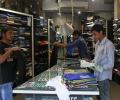
The improvement in business conditions promoted job creation, while confidence towards the year-ahead outlook for activity was at a four-month high during March.
The survey showed firms passed on a greater cost burden to consumers. Prices charged rose at their fastest pace since October.

Risk sentiment is likely to be favourable if oil prices stay benign, global growth sentiment remains robust and the dollar index does not break out, says B Prasanna.

The biggest losers in the Sensex pack were Vedanta, Tata Steel, M&M, Tata Motors, Maruti, Hero MotoCorp, PowerGrid, Bharti Airtel, SBI and Coal India -- falling up to 4.48 per cent.

On the employment front, services employment was unchanged in April.
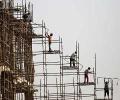
The optimism in global markets could help India as the rebound in GDP is expected to continue and get more broad-based.
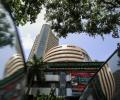
The NSE Nifty, however, ended a shade higher by 6.65 points or 0.06 per cent at 10,442.20

Services growth at 5-month low in Nov as confidence slumps.
.jpg)
The HSBC Emerging Markets Index, a monthly indicator derived from the PMI surveys, sank to 50.6 in June from 51.3 in May, signalling the weakest increase in output since May, 2009.

A reading above 50 represents expansion while one below means contraction.

A reading below 50 means contraction in the sector.
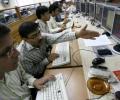
The 30-share Sensex closed down 115 points at 28,444 and the 50-share Nifty ended down 31 points at 8,524.
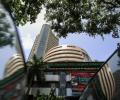
Market sentiment suffered a jolt after other Asian markets closed with widespread losses and European markets dropped in early trade

Traders are waiting for the earnings season to kick off.

A reading below 50 means contraction in the sector.
 © 2026 Rediff.com - Advertise with us - Disclaimer - Privacy Policy - Sitemap - Feedback - About us - Terms of use - Grievances